Using AI in programming
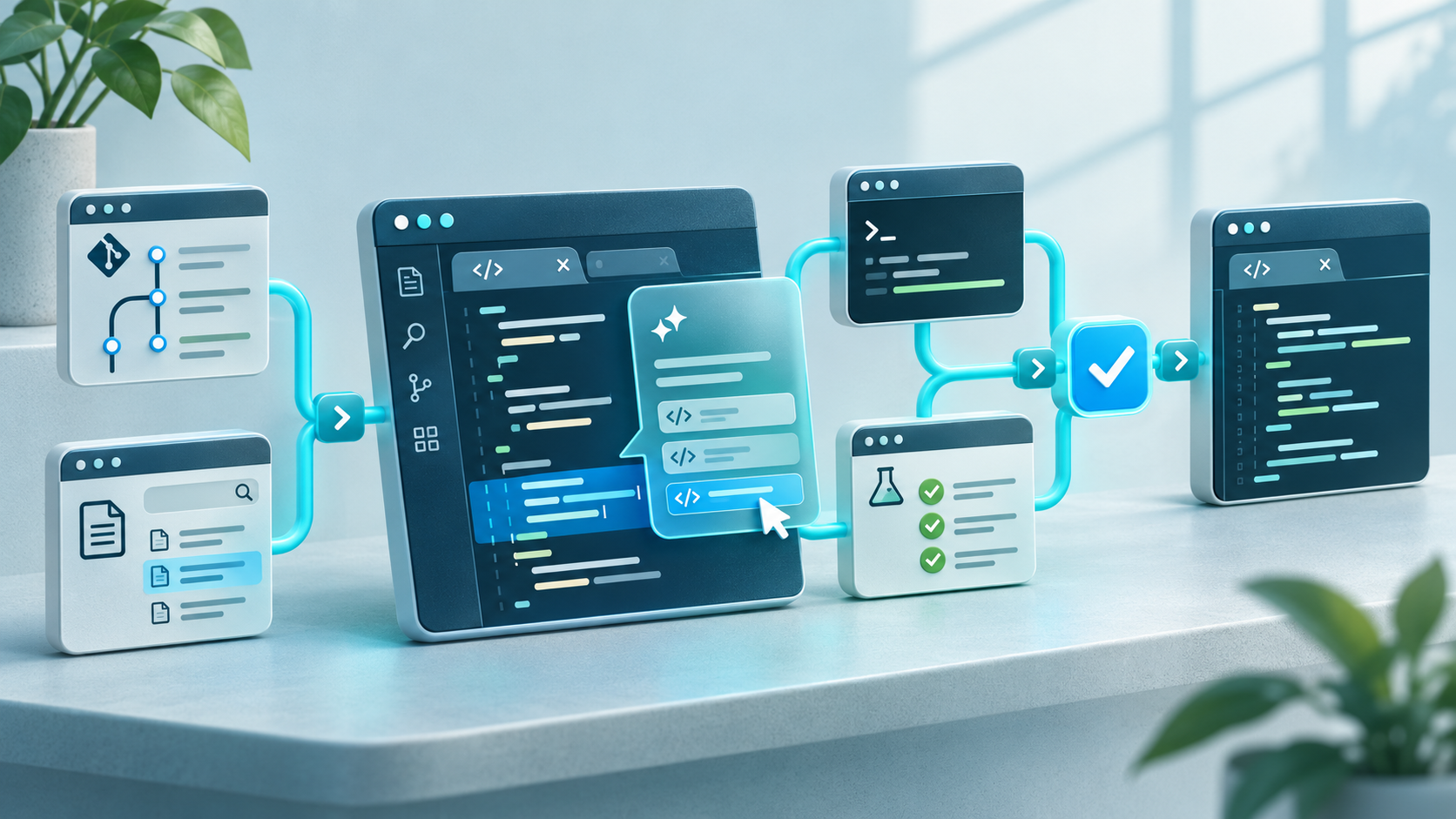
AI helps with understanding code, designing solutions, refactoring and creating tests. We use it as a development partner and review its suggestions in the context of the project.
 DE
AI / RETHINKING SOFTWARE ENGINEERING
We code with AI. But we start with the task rather than the model: what work can be supported, what knowledge can be accessed and what results can be reliably verified?
AI expands our toolkit.
Responsibility stays with people.
Effective AI use starts with a specific task. Together, we explore where intelligent tools can support your development or enable new features.
AI helps with understanding code, designing solutions, refactoring and creating tests. We use it as a development partner and review its suggestions in the context of the project.
AI agents can break tasks into steps, use tools and process intermediate results. For suitable workflows, we examine which steps can be automated and where human approval remains necessary.
Whether knowledge search, assistance features or document processing: we treat AI as part of an application. Interfaces, access rights and business processes are part of the picture from the start.
We bring expertise in deploying local large language models. We help companies use AI on their own infrastructure and make internal information available for their applications in a targeted way.
Local LLMs enable AI processing in an environment under your own control. We consider model selection, hardware requirements and response times alongside your task — for a solution that fits your business and technical needs.
Technical documentation, internal knowledge or project documents: local models can be combined with targeted knowledge retrieval using RAG. This enables assistance features that use relevant context and respect existing access rights.
We connect local LLMs to existing applications and workflows. Interfaces, permissions and traceable quality checks are part of the solution. What matters is how reliably the model supports your specific task.
CONTEXT MATTERS
A language model does not automatically know your application. It becomes relevant through the right context: requirements, code, documentation and clearly defined tools.
Provide the right information at the right time. This includes project rules, relevant code excerpts and a deliberately chosen scope for the model context.
Retrieve relevant content from a knowledge source and provide it to the model as a basis. This can ground answers more effectively; their accuracy still needs to be checked.
A standardised way to connect AI applications with tools and data sources. Appropriate and permitted access is defined explicitly.
We clarify the task, available data and success criteria. A manageable prototype helps identify benefits and limitations before scaling the solution.
Representative test cases, expert reviews and clearly bounded permissions make quality assessable. Failure modes, runtime and costs also need to be considered.
AI must fit existing architectures and processes. Together, we consider integration, traceability and the knowledge your team needs to use it.
AI-generated code is a suggestion. Architecture decisions, tests and reviews remain essential. For data and tool access, we take confidentiality, permissions and project-specific requirements into account.
aformatik uses AI to support understanding code, designing solutions, refactoring and creating tests. Suggestions are reviewed in the project context; architecture decisions, tests and reviews remain part of software engineering.
Here, Agentic AI refers to AI-assisted workflows that can break tasks into steps and call tools. Which steps may run automatically and where human approval is required depends on the specific use case.
RAG provides a model with relevant content from a knowledge source. MCP is a protocol that allows AI applications to connect to tools and data sources. Both can be building blocks of an application, but serve different purposes.